Thursday, 30 July 2009

Live rainbow


I've come across so many people who get so shocked when others do not have knowledge of pieces of information that are of interest to the former. Often, their shock encompasses horror, disbelief and alarm. I used to be so taken aback by how worked up people can get.

As I age, I realize that it's because many people choose to live lives of a single hue, while I choose to live a life of a rainbow.

I'm not the Christian who listens only to Christian music. I'm not the artist who despises yuppies. I'm not the designer who finds engineers and scientists a bore. I'm not the musician who has eyes for nothing else.

It is not that I'm not singleminded, or that I'm unfaithful and distracted. On the contrary, it is precisely because I'm singleminded.

I'm singleminded in my pursuit to experience life in all its fullness. Frequently, even when I know clearly the painful consequences, I plunge head-in, so that I experience yet a new perspective and 'colour'.

I don't dismiss people, even when clear warning signs are given to indicate that they are 'bad news'. Even when past experiences suggest that these difficult people are possibly the same as the ones that had come before, I keep my arms wide open.

I was the jovial child. I was the angsty teen. I was the optimistic everything-will-turn-out-fine lass. I was the crybaby. I was the cynic. I was the trusting. I was the dreamer. I was the realist. I was everything.

Only this way, can I truly empathize with people from all walks. Only this way, can I sincerely weep for others, from my heart. Only this way can I comprehend this world in a much broader perspective, rather than from safety of a water-well's bottom.

Not that anything is wrong with people who choose to live monochromatic. We're all shaped uniquely. Some people strive for safety. We all have different priorities.

Why can't we all live harmoniously, recognizing that some people are just meant to be (or choose to be) colourful, and others, monochromatic? Neither is inherently wrong. Why does everyone instinctively gear for war against those who are different from them, even the slightest difference?

Judgment. Discrimination. Pride. Prejudice.

Why?

Tuesday, 28 July 2009

Copycats - downfall of a civilization


One factor that can lead to the downfall of a civilization/society/empire/nature, is the lack of creativity.

When people cease to contemplate the old ways that were created to suit the old times, and continually apply old ways in changing times, leading to the gradual but definite and unnoticeable degradation of a society.

Art is vital. Creativity is fundamental for survival.

Even cavemen and hunter-gatherers don't rigidly adhere to the old ways, but rather, they apply the experienced, tried and tested methods flexibly to their environment at their point of existence. They adapt creatively. Those who don't, usually die.

Creativity is not stereotypically all about glitz and glamour.

Think.

Sunday, 26 July 2009

Random joke

My mom hurriedly wrote a birthday greeting to my 8 year-old cousin on a Red Packet.

This is what she wrote:

Dear Callista,

Happy Birthday!

Aunty Helen
Niece Janice

Friday, 24 July 2009

Managing giving


There have been too many VDPs (Very Draining Persons), and too little VIPs (Very Inspiring Persons).

Indiscriminating VIPs have to learn to exercise well people and time management skills, lest they burn themselves out, or fall into the VDP category.

There's a point when we need to know when to stop for a while because we all have a threshold and a certain breaking point.

Which is why we need rejuvenation, encouragement and inspiration/cheering up from the VIPs, instead of leading a life perpetually hounded and drained by selfish (whether consciously or subconsciously) VDPs.

Thursday, 23 July 2009

15 minutes of fame, 1 century of poison


Someone and I were talking about how we both preferred the artistes of the 50s to today's.

I was saying that I feel Andy Warhol has a large part to play for how art in all its forms - music, acting, fashion, design, fine arts, etc. - has become today: meaningless and banal. He was the originator and all-time immense advocator of the theory and prediction, '15 minutes of fame'.

Over time, art has evolved to be about the artists themselves, and scarcely anything about the art itself. Whether it be music, design or fine arts, very often, art has become about the artistes, not the art. Effort and quality of the artwork are less important than if the artistes are gaining attention. It has caused people to be hungry about attention. It has caused people who are not interested in music to become musicians, and self-professed art lovers and connoisseurs who really just want to look good.

Even the truly ardent artistes are often distracted and misled by people's constant attention on them instead of their works, and people's pressure on them to emphasize on themselves instead of their works. Sometimes, the pressure leads them away from their works and talents, and causes them to lose their immense potential to what could have been great works of art.

A bistro opened for business at my alma mater art college months ago. Guess the name of the bistro?

Yes, you're right - '15 minutes'.

I thought to myself, "Seriously?"

Wednesday, 22 July 2009

Two blogs?

I've been toying with the idea of having two blogs - one for updates on my life, and another for my insights and contemplations.

Some friends gripe about finding not one post updating my life, especially friends who I don't hang out frequently with.

Some others gripe about my posts being too short (note the recent long posts).

So I have a handful of friends who are into activities updates, and another handful who are into mental-growth updates.

Also, often times, I have to greatly limit myself not to be too wordy when I'm sharing my insights, because the 'activities' friends mostly do not like words.

NTU jogging trails


I can't describe how thrilled I was when I found this link that suggests 13 jogging trails in NTU, according to the level of difficulty.

Not that I'm too lazy to find my own jogging trails, but that I'd really prefer to be given a starter first, since I'm not so familiar with the place yet. I don't want unfamiliarity with the place to be an excuse for procrastination, and leading to zilch exercise. There's a canteen within the Hall I'm staying in. Chloe said the food there is good. So, you see.

Friday, 26 June 2009

Female Genital Mutilation (FGM) in Sudan


This post deals with mature content.

Thus, please discern if you are too prude for this.

What is FGM?

Widely practised in Sudan, FGM can include:

1. Clitoridectomy: Known as sunna in Sudan, this involves the removal of the clitoral hood with or without the removal of all or part of the clitoris.

2. Excision: the removal of the clitoris together with part or all of the labia minora.

3. Infibulation: the removal of all or part of the external genitalia (clitoris, labia minora and labia majora) and stitching or narrowing of the vaginal opening, leaving a very small opening to allow for the flow of urine and menstrual blood. The girl or woman’s legs are usually bound together from the hip to the ankle so that she remains immobile for approximately 40 days to allow the wound to heal.

In the majority of cases, the procedure is carried out without local anaesthetic. The invasive nature of FGM and the unsanitary conditions under which it is performed can lead to serious health complications. These include haemorrhaging and severe pain, which may cause shock or death. The procedure can also cause numerous complications resulting from scarring and interference with the drainage of urine and menstrual blood. This can in turn lead to pelvic and back pain, dysmenorrhoea, infertility, chronic urinary tract infections, urinary stones and kidney damage.

Why is it practised?

Reasons given for the practice include the belief that it will protect virginity. Castledine (undated) explains that FGM is intended to both control women’s sexual drives and cleanse their genitalia by removing the clitoris, which is seen as masculine - the female penis. Brunner explains that uncut women are associated with promiscuity and lack of social respectability. Because of FGM’s association with purity, it is believed that girls who have not been excised have little chance of marriage in countries where FGM is practised.

Taken from:
http://vosesa.org.za/focus/vol3_no3/index.html?article_2.html~content 

Monday, 22 June 2009

It's responsibility.


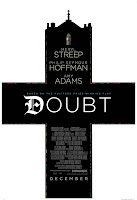
'Doubt', a play and film of the same title and story centers around a nun's unshakable, unprovable and prejudiced belief that a priest has made advances of an improper relationship with one of his altar boys, who is the first and only African-American student in the church's attached school. 

Father Flynn, the compassionate, upbeat and charismatic priest, is working to gradually replace the school and church's rigid legalism with sincere love and kindness. He is fiercely opposed by the 'iron-gloved Principal', Sister Aloysius, 'who believes in the power of fear and discipline' and 'running the school like a prison'.

Sister Aloysius is a cynically loveless, prejudiced and self-righteous character who is unwelcoming towards innovations and unappreciative of creativity and arts. She is strongly reproving towards the use of ballpoint pens, condemnatory towards people adding sugar to their tea, and disparaging towards secular songs. She was prejudiced against the priest and was utterly and irrationally convinced of the priest's 'crime', and was determined to expel the priest, despite having absolutely no evidences against him, but only her own self-righteous certainty.

Due to the excellent relationship Father Flynn enjoys with his colleagues, and the obvious admiration and love that the African-American altar boy has for the Father, as Father Flynn protects the boy from another boy's bullying, Sister Aloysius is downright certain that the priest has a serious problem and that his pedophiliac relationship with the altar boy must be it.

----------------------------------------------------------

Two dialogues from the film:

Sister Aloysius: I'll bring him (Father Flynn) down.
Sister James: How can you be so sure that he is lying (about not having an improper relationship with the black student)?
Sister Aloysius: Experience.
Sister James: You just don't like him! You don't like it that he uses a ballpoint pen. You don't like it that he takes 3 lumps of sugar in his tea. You don't like it that he likes 'Frosty the Snowman' and you are letting that convince you? Of something (the pedophiliac relationship) that's terrible... Just terrible...
Sister James: [Exasperated] Well, I like 'Frosty the Snowman! And I think it will be nice if this school weren't run like a jail. And I think it's a good thing that I love to teach History and that I might inspire my students to love it, too. And if you judge that to mean that I am not fit to be a teacher, then so be it. 


Father Flynn: It's me that cares about that child, not her. Has she ever reached out a hand? That black boy needs help or he's not gonna make it. If she has her way, he'll be left to his own undoing. Why do you think he drank the wine? He's in trouble. And she sees me talk in a human way to these kids and she immediately assumes there must be something wrong with it. Well, I'm not gonna let her keep this parish in the dark ages. And I'm not gonna let her destroy my spirit of compassion. 
Sister James: I'm sure that's not her intent. 
Father Flynn: That I care about this congregation.
Sister James: I know you do.
Father Flynn: Like you care about your class. You love them, don't you?
Sister James: Yes.
Father Flynn: And that's natural. How else would you relate to children?
Sister James: (Stares blankly) 
Father Flynn: Now, I can look at your face and know your philosophy. It's kindness.
Sister James: I don't know. I mean, of course.
Father Flynn: There are people who go after your humanity, Sister. There are people who go after your humanity. They will tell you that the light in your heart is a weakness. Don't believe it. It's an old tactic of cruel people to kill kindness in the light of virtue. There's nothing wrong with love. 
Sister James: Love?
Father Flynn: Have you forgotten the message of our saviour? It's love of people.

----------------------------------------------------------

Doubts. Prejudices. How far can your doubts and prejudices take you? In her quest to 'prove' that the priest is guilty and to expel him, she even declares that she will 'step away from God' and be 'damned to hell' as she does 'what needs to be done' (she lied blatantly).

Sadly, even in today's age, in spite of the widespread message and teaching of Jesus' love, many followers still allow their prejudices and self-righteousness to take control of them as they consciously set out to devastate individuals' reputations and lives, in various ways, especially with gossip and defamation.

The Sister threatened the Father to leave, or risk having her openly fight him by declaring his 'crime' aloud. Taken aback by the hostility of the Sister, the Father asked him where her compassion is, and she replied "Nowhere you can get at it".

Ultimately, he decided to leave the church. But his superior (the head pastor) not only transferred him to another church and its attached school, but promoted him as well.

"Since he's innocent, why did he leave?", you would ask. 

Haven't we all witnessed scores of examples around us that the accusation and/or gossip about a person committing a crime can be equally damaging as having been convicted of the crime?

When you are accused of such a crime, your reputation is equally ruined and the trust you have built with others damaged as well. You don't even need to be guilty.

What more, this Sister is insanely and strongly intent on bringing him down, and she sure has the shrewd ability to do so. Instead of focusing on God's work and loving the students and congregation, the Father would have to be distracted with the need to fight with her.

When people are obstinately unrepentant and bent on destroying you, what do you do? Do you stay on to be 'responsible' for them? Do you stay on, so as to show you have a clear conscience? Do you stay on so you can clear the misunderstanding? 

Staying on seems to be the right, responsible and heroic decision, isn't it? But, does it work for every situation?

Should Father Flynn have stayed on to 'fight' Sister Aloysius, by allowing her to accuse him and declare to the congregation his nonexistent crime? Should he have stayed on to explain to the congregation that he was being accused and instead, expose Sister Aloysius' insanity to everyone? That would have driven Sister Aloysius really mad, literally. That would have sent her into isolation, solitariness, shame and disillusionment. That might have wrecked her of any possible shred of a chance at repentance and salvation. 

Also, you might argue, that he could have stayed on and tried to enlighten and change her. Really, you really think it's possible after all his failed attempts to connect with and communicate with her and with her prejudice like an extremist's?

Instead, if he leave... She would be left in quietness to reflect on all that has happened. And he'd be given a chance to show her and everyone his integrity, as he pastor and lead another church and school. The future happenings and outcome would show and tell her what he really is. While he's elsewhere doing good, she's somewhere hearing about all his goodness and be left by herself to reflect on the past.

Sometimes, you don't need to be 'there' to actually impact a person. You don't need to be 'there' to directly talk to a person to enlighten him/her.

Sometimes, leaving is the responsible thing to do.

God spoke to me through a film, again.

Sunday, 21 June 2009

Gossip - feathers on wind


A sermon that was given by 'Father Flynn' in the film, 'Doubt'.

"A woman was gossiping with her friend about a man whom they hardly knew - I know none of you have ever done this (an ironical joke that set the congregation laughing). That night, she had a dream: a great hand appeared over her and pointed down on her. She was immediately seized with an overwhelming sense of guilt.

The next day she went to confession. She got the old parish priest, Father O' Rourke, and she told him the whole thing. 'Is gossiping a sin?' she asked the old man. 'Was that God All Mighty's hand pointing down at me? Should I ask for your absolution? Father, have I done something wrong?'

'Yes,' Father O' Rourke answered her. 'Yes, you ignorant, badly-brought-up female. You have blamed false witness on your neighbor. You played fast and loose with his reputation, and you should be heartily ashamed.' So, the woman said she was sorry, and asked for forgiveness.

'Not so fast,' says O' Rourke. 'I want you to go home, take a pillow upon your roof, cut it open with a knife, and return here to me.' So, the woman went home: took a pillow off her bed, a knife from the drawer, went up the fire escape to her roof, and stabbed the pillow. Then she went back to the old parish priest as instructed.

'Did you cut the pillow with a knife?' he says.
'Yes, Father.'
'And what were the results?'
'Feathers,' she said.
'Feathers?' he repeated.
'Feathers; everywhere, Father.'
'Now I want you to go back and gather up every last feather that flew out onto the wind.'
'Well,' she said, 'it can't be done. I don't know where they went. The wind took them all over.'
'And that,' said Father O' Rourke, 'is gossip!'"